

Description
Target Information
Blood-based biomarkers for Alzheimer’s disease (AD) are advancing rapidly, particularly those that detect beta‑amyloid (Aβ) and phosphorylated tau (pTau) pathology. The practicality and scalability of accurate blood tests have significant implications for accelerating clinical research and improving diagnostic workflows. Current candidate markers include mass‑spectrometry and immunoassay measurements of Aβ42, Aβ40, their ratio, and multiple phosphorylated tau species such as pTau217 and pTau181. Additional non‑specific indicators of neurodegeneration and astroglial activation—most notably neurofilament light (NfL) and glial fibrillary acidic protein (GFAP)—also contribute valuable information.
Tau, a microtubule‑associated protein essential for neuronal structure, is a central neuropathological feature of AD. Hyperphosphorylation of tau is believed to drive pathological propagation and neuronal loss. Recent studies consistently show that plasma pTau217 levels are elevated in individuals with AD, rise early along the disease continuum, and correlate strongly with amyloid‑PET positivity. These characteristics position pTau217 as a particularly promising blood‑based biomarker for research, therapeutic development, diagnosis, disease staging, and patient management.
Growing evidence highlights the superior performance of pTau217 compared with pTau181. In autosomal dominant AD, cerebrospinal fluid pTau217 increases earlier and more distinctly differentiates AD from non‑AD causes of cognitive impairment. In plasma, pTau217 reliably distinguishes neuropathologically confirmed AD from other dementias. Plasma pTau217 concentrations measured in vivo also correlate with ex vivo protein levels and regional tau burden in post‑mortem brain tissue.
Furthermore, plasma pTau217 effectively separates diagnostic groups defined by amyloid‑PET status. Among cognitively impaired Aβ‑positive individuals (AD or mild cognitive impairment), pTau217 levels are significantly higher than in cognitively unimpaired Aβ‑negative participants, and plasma pTau217 shows moderate to strong concordance with tau‑PET signal. Longitudinally, pTau217 remains low and stable in Aβ‑negative MCI but increases over time in Aβ‑positive individuals, further enhancing its diagnostic and prognostic value.
Collectively, these findings underscore pTau217 as one of the most robust and informative blood‑based biomarkers currently available for Alzheimer’s disease research, drug development, diagnosis, disease monitoring, and clinical care.
Product Specification
- Host: Rabbit
- Antigen: Tau (phospho T217)
- Synonyms: p-Tau217, phospho T217
- Immunogen: Synthetic peptide
- Accession: P10636
- Clone Number: SDT-176-4/SDT-176-13/SDT-176-213/SDT-176-235
- Antibody Type: Rabbit mAb IgG
- Application: Sandwich ELISA
- Predicted Reactivity: mouse
- Purification: Protein A
- Concentration: 2 mg/ml
- Physical Appearance: Liquid
- Storage Buffer: 1x PBS, pH 7.4, 0.03% Proclin 300
- Stability & Storage: 12 months from date of receipt / reconstitution, 2 to 8 °C as supplied.
Recommend Dilution
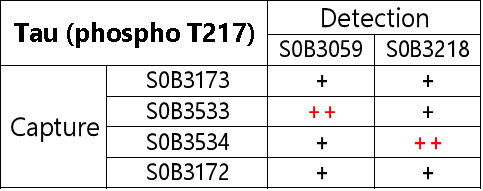
Sandwich ELISA: N/A. Suggested paired antibody, S0B3059 and S0B3218.


Reviews
There are no reviews yet.